
A New Atlanta-Made Robot Is Targeting Last-Mile Delivery
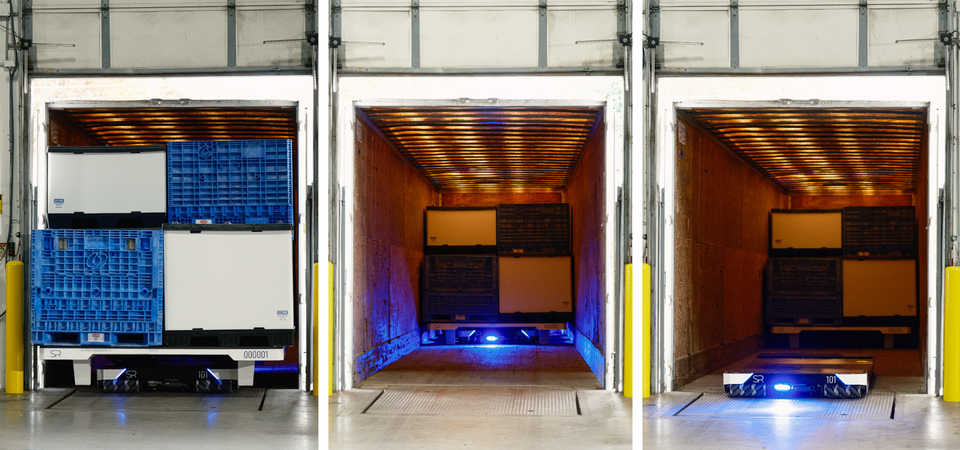
Slip Robotics, Atlanta’s growth-stage robotics company focused on the logistics industry, is out with a new product that will grow its customer base into new verticals.
The company announced today the launch of its new robotics platform, SlipLift. The platform decouples the robot from the payload, allowing it to handle longer delivery routes, heavier loads, and last-mile deliveries—going well beyond the quick, back-and-forth trips its first product was designed for.
The system requires no Wi-Fi, software integration, or infrastructure changes, using cameras and sensors to navigate autonomously. "Humans remain in the loop as orchestrators, not drivers," said Dennis Siedlak, Chief Product Officer at Slip Robotics.
This “fundamentally changes the economics” around using robots inside a warehouse loading dock, says CEO Chris Smith. “Robots are expensive assets. Trays are not. By leaving trays on trucks instead of robots, customers can achieve ROI on longer and less frequent routes. It also opens the door to new applications like regional networks, supplier inbound, and last-mile delivery.”

Slip Robotics said that SlipLift can help the company capture new customers with medium and long-haul routes, including food and beverage businesses, CPG, heavy manufacturing, regional distribution networks, and final-mile box truck delivery.
“Docks are chaotic environments. Operators handle exceptions like damaged pallets or unexpected traffic. Our philosophy is minimal touches: point and click a few times, and the robot does the rest. The operator becomes an orchestrator, not a forklift driver,” added Siedlak.
Signs Of Growth
Hypepotamus last covered Slip Robotics in 2024, following the startup’s $28 million Series B fundraise. The company is backed by Southeast investors like EVE Atlas, Overline, and Tech Square Ventures.
SlipLift builds on the startup’s previous product, SlipBot, which can load and unload any truck in just five minutes — a process that typically takes up to 60 minutes — without any infrastructure modifications needed.
“SlipBot validated our core thesis around short-haul, high-frequency transportation. More importantly, it gave us hundreds of thousands of real-world dock cycles,” added CEO Smith. “We learned what docks actually look like, how operators behave under pressure, how hardware fails, and what serviceability really means in an industrial environment. Those lessons directly shaped SlipLift.”
Smith said that the two are “complementary tools” since “many customers will use both across different parts of their network.”
SlipLift works to improve the three common constraints seen with SlipBot: Payload capacity, route length, and frequency.
“SlipBot is excellent for closed-loop, high-frequency routes, but some customers needed heavier payloads, longer or one-way routes, or fewer turns per day while still achieving return on investment (ROI). Rather than forcing SlipBot into those use cases, we designed a complementary product,” Smith added.
Related Articles
Robot-as-a-Service Startup Lands $28 Millions Series B From Bay Area “Deep Tech” VC
Undaunted Takes on Security with Robotics and Real-Time Solutions
French Robotics Company Exotec Eyes Major Atlanta Expansion In 2025




Comments ()