
Discussing the Gap Between Creative and Tech
"Ask the challenging questions, if you can google it — don't ask it."
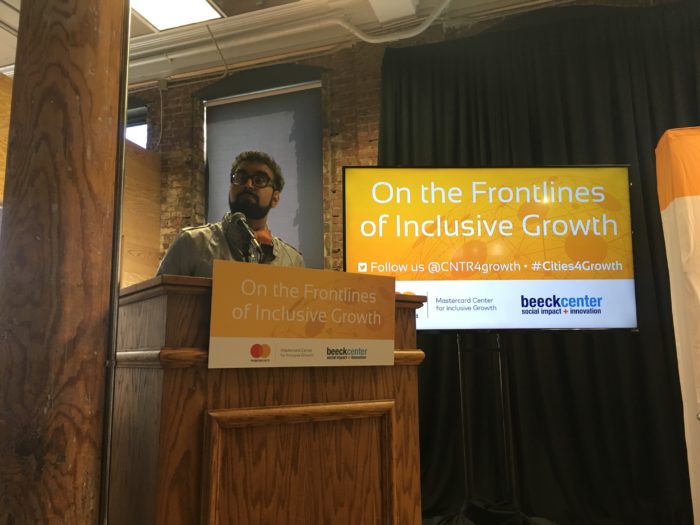
Rohit Malhotra said as he kicked off the Mastercard Center for Inclusive Growth's panel discussion on building the digital economy. The event brought together members of the city's government, non-profits, businesses, and others to discuss how to engage more voices in the local economy. It was hosted by the Center for Civic Innovation and the Beeck Center for Social Impact & Innovation at Georgetown University.
"People are not data points, they are rooted in cultures and traditions that we know so well in this city. That data is meant to inform us on how we move forward, not whether we do it at all," said Malhotra, founder and executive director of the Center for Civic Innovation.
"We had a conversation with Rohit and a number of other people in this room to try to get a sense of what are the key issues in Atlanta," said Craig Vosburg, president of Mastercard North America, building on Malhotra's remarks. "We won't be able to address all of them, but we're hoping that these conversations will be able to highlight something we would be able to support. I want to encourage you to listen and learn."
Touring through New York City, Atlanta, Oakland, and Washington, D.C., the Beeck Center hopes to engage local entrepreneurs and help them drive social change in their city through panel discussions led by community and business leaders.
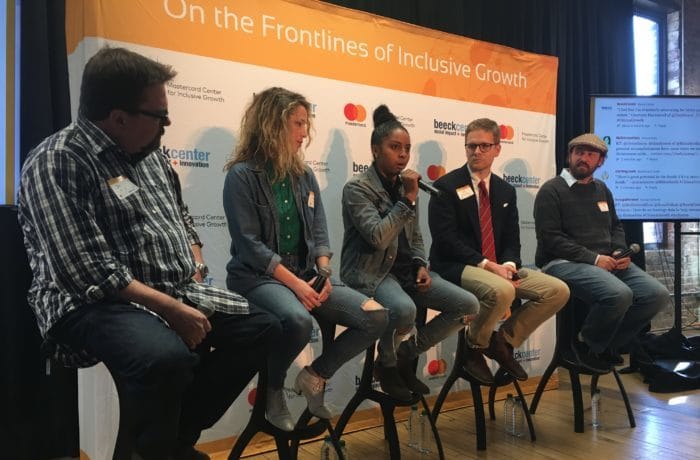
Moderator Chuck Reece, co-founder and editor-in-chief at The Bitter Southerner, posed the question: how can we help fill the gap between big enterprises and creative people and become more inclusive as a city?
"In Atlanta, we separate the tech and artistic communities. It's easy to stay within your four walls. We need to merge," said Partnr's Amanda Sabreah, one of the panelists. "Get out of your four walls!"
That's how Sabreah's tech startup Partnr came about. It's a collaboration platform for creatives and businesses to build fast and flexible teams with outside talent for projects.
"Pay artists," Courtney Hammond from Dashboard agreed. "The more we are able to pay the creators of visual and performing work, the wider our net is cast for communication across a diverse sector. The amount of access that this offers up in communities just organically is so powerful."
Panel included Sabreah, Courtney Hammond from creative non-profit Dashboard, Lain Shakespeare from MailChimp, and Matt Weiss from A3C Hip Hop Festival.
"Businesses really can't remain competitive without working with artists," said Hammond.
Art is meant to challenge the status quo. Many businesses don't know where they fit in in this community and how to align it with profitability. One of the companies succeeding at this is MailChimp as they continue to merge creative talent and tech through its corporate culture.
Shakespeare, currently corporate citizenship manager at MailChimp, believes that hiring people of different backgrounds, not just tech, benefits the company's mission as a whole. "It affects how we work with the community and it's not a top-down philanthropic approach, but it's a service approach. Inclusion just isn't recognizing folks, but also how do you treat them," said Shakespeare.
Sabreah agreed. "At Partnr, we're trying to give you access, so you can sustain yourself on your art. How are corporations enabling millennials and freelancers to do the things they love to do for a living?"
It's an ongoing issue of profits versus taking a risk. "Think about how you express your company's purpose and your brand values in the real world," said Shakespeare.
"Our business purpose is to give the underdogs the tools to succeed. Translating that into arts is really easy. There's an opportunity for us to invest in small, medium-sized arts organizations and I feel that this is how we are expressing inclusion in a way no one else is doing it because of risk. Founders focus so much on outcomes, but why can't we focus on the creative process?" said Shakespeare.
Companies often hesitate to reach out to new communities because of fear of risk. "Talk to people in different communities, understand what they are going through. It's not like in the tech world when you hear 'customer data,' it's not that," said Sabreah. "It's being able to take a cultural thermometer and understand what's happening in the world so you can better serve those communities that you're trying to help.
By being inclusive, you're bringing in different perspectives into your company that can help with problem solving and brand engagement.
"When we make assumptions, we're often wrong. Take a chance and engage with something you're unsure about," said Reece to end the panel.
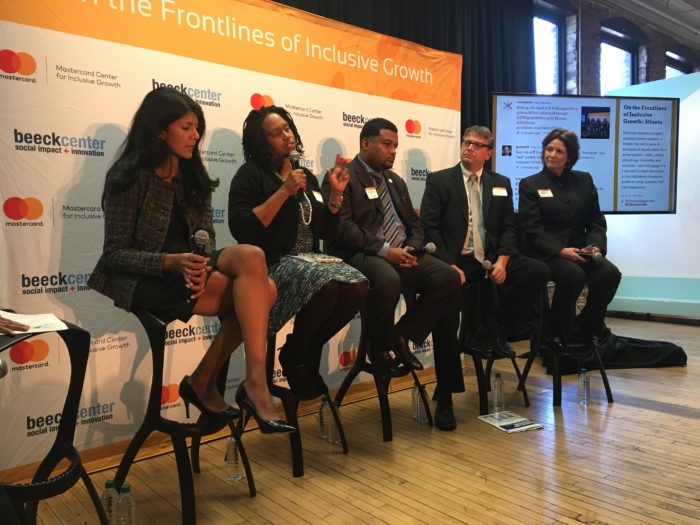
A second panel was led by Beeck Center's Sonal Shah and included Mike Carnathan from Neighborhood Nexus ARC, Duriya Farooqui from the Atlanta Committee for Progress, Grace Fricks from Access to Capital for Entrepreneurs, Lesley Grady from Community Foundation of Greater Atlanta, and Nathaniel Smith from Partnership for Southern Equity.
Follow the hashtag #Cities4Growth on Twitter for discussions about inclusive growth in Atlanta and beyond.

Comments ()